
Markets end flat ahead as investors turned cautious and booked profits ahead of Jan IIP, Feb CPI data.
Markets surged nearly 2% led by IT majors on better-than-expected Q3 earnings from Infosys and hopes that RBI would continue to maintain status quo on key policy rates.

The rate of price rise in the vegetable segment almost doubled to 7.47 per cent as against 3.92 per cent in September.
Banks and Capital Goods scrips among the top losers in noon deals.

If the pattern over the last three months is going to continue, the likelihood is that both indices will register inflation rates close to current levels over the next few months.

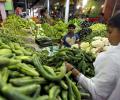
Among food articles, vegetable prices surged by 69.69 per cent mainly on account of onion, which witnessed 455.83 per cent jump in prices, followed by potato at 44.97 per cent.

The retail inflation, which is factored in by the RBI to arrive at its monetary policy, has been on decline since last month. The previous low was 5.54 per cent in November 2019. The government has asked the RBI to restrict the inflation around 4 per cent, with a margin of 2 per cent on the either side.

'Inflation is not good for industry. Nor for the economy as a whole.'

Health insurance premium growth has slowed after touching record highs during the Covid-19 pandemic due to tapering demand from retail consumers amid affordability issues. According to General Insurance Council data, health insurance premiums grew by 10.44 per cent year-on-year (Y-o-Y) in the Apr-Jan period of FY25 in comparison with 20.79 per cent in the year-ago period. It was around 23.57 per cent in FY23, and 25.89 per cent in FY22.
South India relatively insulated from the increase in prices.

American brokerage BofA Securities on Friday said the Indian economy continues to be "weak", pointing to activity indicators tracked by it. On the positive side, the brokerage said credit demand is bottoming out and the real lending rates adjusted for wholesale price inflation are falling. It can be noted that there has been a slew of reports lately about a stronger recovery being underway after the jolt caused by the pandemic.
The rupee has already shed around 3.3 percent over the last five sessions.

India's services sector activity fell to a 10-month low in September as new businesses, international sales and output growth moderated, a monthly survey said on Friday. The seasonally adjusted HSBC India Services Business Activity Index fell from 60.9 in August to 57.7 in September, indicating that though the output registered an increase, the pace of growth was the slowest since November 2023. In the Purchasing Managers' Index (PMI) parlance, a print above 50 means expansion, while a score below 50 denotes contraction.

Despite its recent underperformance, gold must be a part of your portfolio.

Retail inflation rises to 4.41% in Sep on dearer food items

'A 10 to 15 per cent allocation to gold in portfolios reduces risk without compromising on potential returns.'
Monetary tightening by the Reserve Bank of India to control the sharp rise in prices has checked the march of Indian consumers up the consumer electronics value chain.

The Reserve Bank on Wednesday hiked key benchmark policy rate by 25 basis points to 6.5 per cent, citing sticky core inflation. This is the sixth time interest rate has been hiked by the Reserve Bank of India (RBI) since May last year, taking the total quantum of hike to 250 basis points. Announcing the bi-monthly monetary policy, RBI Governor Shaktikanta Das said the Monetary Policy Committee (MPC) by a majority decided to raise the policy repo rate by 25 basis points and keep a 'strong vigil' on inflation outlook.
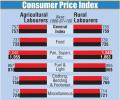
In case of rural workers, the index recorded an increase between 1 to 7 points in 12 States, and a decrease between one to 8 points in 8 states.

India is among the three least-favoured Asian stock markets, according to BofA Securities whose survey found that 10 per cent of fund managers are underweight on Indian equities from a 12-month perspective.

'Future market gains will likely depend primarily on earnings growth.'
The Reserve Bank of India's rate-setting panel on Wednesday began its three-day deliberations on the next bi-monthly monetary policy amid expectations of at least a 35-basis-point hike in the interest rate to check high inflation. If raised, it will be the third consecutive hike in the repo rate -- the short-term rate at which the RBI lends money to banks. The central bank has already announced to gradually withdraw its accommodative monetary policy stance.

The Reserve Bank is expected to go for another rate hike of 0.40 per cent at the scheduled review of the monetary policy next week, a foreign brokerage said on Friday. The central bank's rate setting panel will follow it up with a 0.35 per cent hike in rates at the next review in August, or make it into a 0.50 per cent hike next week and a 0.25 per cent increase in August, to make the total quantum of rate hikes at 0.75 per cent, the report by Bofa Securities said. On May 4, the Reserve Bank of India (RBI) hiked rates by 0.40 per cent, and Governor Shaktikanta Das has already called a rate hike at the forthcoming review as a "no brainer" given the pressure to maintain its core mandate of inflation in the targeted band of under 6 per cent.
Expressing concern over the impact of rising crude oil prices on Indian economy, Prime Minister Manmohan Singh on Monday said it can have adverse consequences for the economy. "We cannot allow the subsidy bill to rise any further," Singh said and appealed to all the political parties to adopt a wider consensus on the pricing issue.

Though inflation, on the basis of the wholesale price index, is nowhere near the 1990-91 level of 10.26 per cent and India is in a much better position to check it, the greater integration of our economy with the globe has exposed it to a much higher risk of imported inflation.

The ongoing second quarter earnings, movement of oil benchmark Brent crude and the uncertainty in the Middle East would dictate terms in the domestic markets this week, analysts said. Furthermore, the activities of Foreign Institutional Investors (FIIs) will also influence trading in the markets. "A slew of earnings reports from heavyweights expected this week will significantly impact market direction.

Foreign flows into Indian equities are expected to pause in the short to medium term, say analysts. The outlook is influenced by multiple factors, including rising oil prices, actions from global central banks, climbing bond yields, and the dollar index gaining prominence. "Valuations appear rich with the markets at record highs.
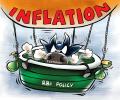
Inflation breached the upper end of the RBI's comfort level of 4 per cent plus-minus two percentage points.

India's overall retail inflation eased to 4.41 per cent in September, helped by falling commodity prices, but rural inflation was at 5.05 per cent
The RBI, which mainly factors in CPI for arriving at its bi-monthly monetary policy, has been mandated by the government to ensure that inflation remains at 4 per cent, with deviation of 2 per cent on either side.

8 out of 10 households are planning to cut their tomato consumption if prices stay in the Rs 75-150 kg range over the next three months.

Finance Minister Nirmala Sitharaman on Thursday said India has ramped up the import of crude oil from Russia at discounted prices amid sanctions on Moscow as part of the country's inflation management. "In a situation where global prices were going beyond anyone's affordability, at that stage to take a very strong political decision, I respect the prime minister for his courage on this to get it from Russia because they are ready to give it to you at discount. And how speedily did we manage to do it," she said. India ramped up its import from Russia from about 2 per cent of the total shipment of petroleum products to 12-13 per cent in a couple of months as part of inflation management, she said at a seminar organised by economic think-tank Icrier.

Industrial output had slowed to 5-month low of 2.1% in March.

On overall basis, the inflation in the food segment increased to 4.42 per cent in November as compared to 1.9 per cent in the preceding month.
Inflation rate in fuel and power segment was (-)16.50 per cent.

Food inflation was 7.79 per cent last month, higher than a revised 7.47 per cent in May

Retail inflation measured by the consumer price index has risen sharply across food and non-food constituents, including services, keeping inflation expectations high, the Reserve Bank of India said in its Second Quarter Review of Monetary Policy 2013-14.

The government on Wednesday asked the Reserve Bank to maintain retail inflation at 4 per cent with a margin of 2 per cent on either side for another five-year period ending March 2026. To control the price rise, the government in 2016 gave a mandate to the RBI to keep the retail inflation at 4 per cent with a margin of 2 per cent on either side for a five-year period ending March 31, 2021.

Deputy Governor Michael Patra warned about the spillover effects of food inflation.
The Reserve Bank remains laser-focused to bring back retail inflation to 4 per cent over a period of time in a non-disruptive manner, Governor Shaktikanta Das stressed while voting for status quo in interest rates, as per minutes of the October policy meeting released on Friday. The central bank has been mandated by the government to ensure the Consumer Price Index (CPI) based inflation is at 4 per cent, with a band of 2 per cent on either side. The retail inflation, which was above 6 per cent during May and June, has started moving down and stood at 4.35 per cent in September.
 © 2026 Rediff.com - Advertise with us - Disclaimer - Privacy Policy - Sitemap - Feedback - About us - Terms of use - Grievances